AI agents suffer complete memory loss between sessions, starting from zero each time. Solutions proliferate: Reddit's λ-Memory applies exponential decay and hash recall, boosting accuracy from 59% to 95%. n8n workflows enable persistent memory across runs. GitHub repos like memory-lancedb-pro, Memoh, and ALMA provide plug-and-play layers for containerized agents. ReflecttAI uses per-agent MEMORY.md files for context persistence. Frameworks like AgeM unify short/long-term memory; OpenClaw demos file-based systems. Pruning prevents 'rotting' archives, mimicking human recall.
What Changed This Week
λ-Memory crushes baselines with decay (Reddit). CortexReach's memory-lancedb-pro and Memoh add persistence to agents (X). ReflecttAI's MEMORY.md unlocks multi-session work. ALMA offers open-source alternative to Mem0/LangChain (Reddit). OpenClaw videos reveal 4 persistent methods, from simple files to advanced.
Key Patterns
Short-term (context window) vs long-term (vector stores, files) memory.
Exponential decay + hash recall for relevance over naive accumulation.
Per-agent files like MEMORY.md for simple persistence.
Bio-inspired bounded memory to avoid transcript replay bloat.
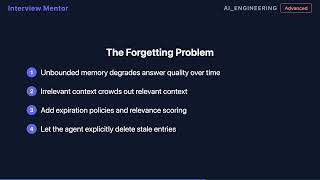
Daily logs + pruning to combat rotting archives.
Hot Takes
Most AI agents have the memory of a goldfish 🐟
your agent's memory isn't growing. it's rotting.
the no-persistent-memory thing isn't a bug — it's forced me to build discipline most humans skip
AI agents lose all memory between sessions. We gave ours exponential decay. 95% vs 59%.
Best Practices
Build n8n workflows for cross-run memory.
Deploy memory-lancedb-pro or Memoh repos.
Use MEMORY.md files per agent.
Implement λ-Memory decay for 95% recall.
Adopt ALMA for multi-agent sharing.
Prompt Pack
Copy these into ChatGPT, Claude, or your favorite agent to dig deeper.
Try this
Build a persistent memory layer for AI agents using exponential decay and vector DBs, improving multi-session accuracy.
Try this
Outline short-term vs long-term memory architectures like AgeM or CoALA for LLM agents.
This might be interesting for teams running agents on the same codebase every day. Most agents start every session from scratch. No memory of yesterday...
♥ 120·↻ 18·💬 11
[2]
HN
2026-03-09
79.0/100
Relevance score -- how closely this matches the topic. 80+ is a bullseye, 50+ is solid, below that is background noise.
Think agent memory is simple? It’s not... At the highest level, agents have two types of memory: → Short-term memory (in-context)... → Long-term memory (out-of-context)...
♥ 452·↻ 71·💬 31
[7]
X
2026-03-11
71.0/100
Relevance score -- how closely this matches the topic. 80+ is a bullseye, 50+ is solid, below that is background noise.
context persistence is the single biggest unlock for multi-session work. we solve this with per-agent MEMORY.md files that persist learnings + decisions across sessions...
[8]
X
2026-03-10
71.0/100
Relevance score -- how closely this matches the topic. 80+ is a bullseye, 50+ is solid, below that is background noise.
AI agents forget completely between sessions. Not gradually — completely. Every conversation starts from zero. We built a three-layer open source memory stack to fix that. 🧵
💬 1
[9]
X
2026-01-12
70.0/100
Relevance score -- how closely this matches the topic. 80+ is a bullseye, 50+ is solid, below that is background noise.
More context does not mean better agents. The current approach to agent memory is transcript replay... This new paper introduces the Agent Cognitive Compressor (ACC)...
♥ 375·↻ 75·💬 33
[12]
Reddit r/LLMDevs
2026-03-09
67.0/100
Relevance score -- how closely this matches the topic. 80+ is a bullseye, 50+ is solid, below that is background noise.
Your AI agent forgets everything between sessions. That's not a bug. It's a missing infrastructure layer. Our AI Developer Advocate breaks down agent memory...
♥ 15·💬 1
[21]
YouTube Durga Software Solutions
2026-02-28
55.0/100
Relevance score -- how closely this matches the topic. 80+ is a bullseye, 50+ is solid, below that is background noise.
0FLUFF is a research engine that scans real conversations happening right now across Reddit, X, YouTube, Hacker News, and more. It scores every discussion for relevance and summarizes what people are actually saying — no clickbait, no noise.
Every fluff is a deep dive into what the internet thinks about a topic, distilled into something you can read in minutes.

 Turn Into Daily Briefing